
An Interview with the director-duo behind The Offing: Koko Crozier and Lily Lunder
by Montana May
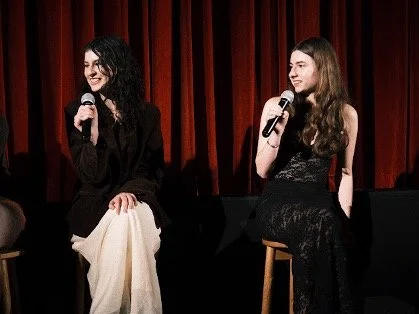
Lily Lunder and Koko Crozier. Photo by Kim Li.
Filmmakers Koko Crozier and Lily Lunder debuted their new psychological thriller feature film The Offing (2025) accompanied by short film SNAP (2025) at the 2026 Melbourne Women in Film Festival. The pair have been directing, producing, and writing short films together since they were met during university at seventeen. They have established their unique voice and flair for the macabre on collaborative shorts like Xenos (2023), The Backwater (2022) and Stonewall (2024).
Despite the undeniably palpable energy that the duo have when directing together, they each have thriving solo solo projects. Crozier, is the CEO and Chair of Bishop's Hook Productions and director behind MWFF’s Best VIC Next Gen Short Film Award winner Mother (2026). Lunder is the founder of Iris Artists Inc and creator behind 2019 Tropfest JR finalist Reboot (2019).
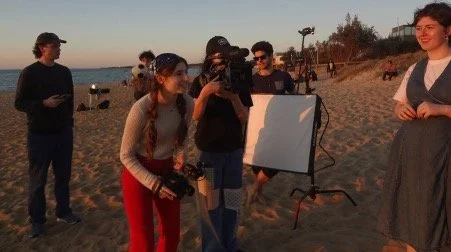
Crozier and Lunder on set of The Offing. Photo by Rena Li.
How did you choose the title?
Lunder: we spent a long time trying to think of what would be good title for this film and what term could encapsulate its essence. We researched synonyms for the future, as it’s a key theme in the film, and we found in the offing. Personally, I did not know what that meant discovered that it’s an old idiom that refers to kind of the distant horizon where the sea meets the sky. Evidently, the sea is a big part of the film as well, and water is significant in reference to Neviah’s character. Plus, a lot of people think the offing just means the killing as well. A holistic title.
Could you speak to the offing ritual presented in the film? Its implied that the title also refers to a sort of ceremonial rite within the cult from Neviahs past, like in the bathtub scene. What actually occurs within the ritual and why? It remains somewhat ambiguous to the viewer like is it a sort of drink the kool-aid thing?
“look ahead to the offing…”
Crozier: We had a lot of fun diving into the lore of the cult and building this kind of religious world, and it’s very much inspired by Norse mythology. We particularly grounded it around this figure called Frigg, who's kind of the goddess of motherhood and fertility, but also, she's a seer who can predict the future. We liked this idea of a cult that worshipped her and wanted to bring out similar abilities in their women. So, there is a ritual in the film, this may be a bit of a spoiler, but they're kind of trying to induce a flash forward in which Neviah can see into the offing and tell them what she finds. So, yes, she gets submerged in a bath and kind of waterboarded in various torturous practices in an attempt to induce visions of the future. They're kind of a doomsday cult as well… They want to protect themselves against what's to come.
Wow having the backstory about Frigg clears up so much. To speak more about the Norse mythology and apotropaic symbols like the amulet that Neviah wears from her mother. Could you discuss the significance of the amulets that the cult members wear?
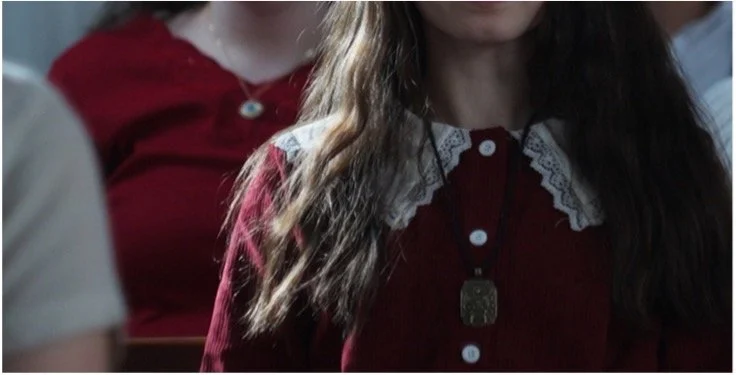
The amulet in The Offing.
Lunder: Thanks for picking up, the symbol on the amulet is Mother Frigg who (as you found out before) the cult worships because she’s symbol of fertility, the future, and is a strong feminine figure. In the cult they all have the amulets that get passed down. These were our driving thoughts on the cult’s lore and how it functions, it’s very much subtly implied within the film so I’m glad you picked up it.
Crozier: We also kind of use the amulets as a tool to delineate where the women were at in this stage of their life in relation to the cult. Before Neviah comes of age and has her period, she's wearing her mother's amulet, that's passed down. As for the women who are fertile and, in turn, fertile to the gift, of seeing the future they wear a necklace with an eye on it to kind of represent the idea of foresight and to encourage the gifts to manifest. So Neviah actually swaps her necklace for an eye when she has her period. There are lots of other little Easter eggs hidden in the film.
Excellent segue into discussing the red and white outfits that the cult member’s wear. One could observe a parallel to Margaret Atwood’s The Handmaid's Tale.
What literature, films, directors, you know, take inspiration from, or if you pay homage to any of them within your work?
Lunder: Absolutely, think the costumes for the cult were very much Handmaid’s Tale inspired. Red is just such a striking colour, especially when it's contrasted with green or lighter things in the background. In the scenes where Neviah and Freya are sitting in the lush grass in long white dresses and white skirts, this felt very Picnic at Hanging Rock to us - which heavily inspired our costuming.
Crozier: also, this may not necessarily come to mind first but at the time when we were filming and actively rewriting the film, a lot of us were watching The White Lotus season two. And we were drawn to the way that they used the ocean as a foreboding tool, and how they cut back to it. The ocean mirrored the tension that's going on with the characters. So we're very much inspired by the way they draw on the landscape to generate that suspense and tension. But also, in terms of the chronology of the film and playing the time, we really enjoyed Arrival (2016) and the way it, distorts time in a way that, subverts audience expectations. It’s also deeply rooted in emotion and connected to the characters autonomy and sense of agency.
I can definitely see how the bold costuming in season two of the white lotus and the whimsical style in picnic at hanging rock could have influenced the attire in the offing. The costuming seems to defy timelines too with Neviah’s 1970s brown and orange patterns, Freya’s eclectic styling that features a 1960s beehive and blue eyeshadow in one scene and the 1800s style gowns. What were your thought processes with costuming and how colour symbolism and period specific style were used in the film?
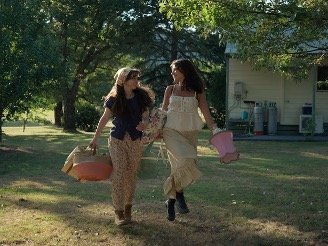
Costuming in The Offing.
Lunder: In terms of the costuming, we definitely wanted to reflect the characters’ journeys and how it changes with the landscape that they are in. I feel like Freya’s wardrobe is quite responsive to her surroundings – she’s got quite a free and colourful aesthetic in comparison to Neviah’s. We also wanted Neviah’s costumes to change as she slowly comes out of her shell. At the beginning of the film she wears more conservative and darker clothing, but slowly starts to show a bit more skin and experiment with colour. At the carnival, you see she's in a very bright and playful outfit that we imagine was probably a Freya makeover.
Crozier: we had a lot of fun with the costumes and wanted to keep the pieces very timeless, drawing costume inspiration from the fashion of different periods, because the themes within the work kind of transcend time in that same way, speaking to the subjugation of women that's existed throughout time. In the cult, it's a bit more historical, with the 1800 silhouettes, then we make our way more into the 1970s, which was big on caravan culture, also relevant because that was the time period where infamous cults were forming. We were drawn to the aesthetics of that but wanted to keep it open.
You filmed in lots of different locations, one being around the Dandenong ranges. I wondered if you took some inspiration from the local cult The Family from Olinda?
Lunder: Very much so. We were inspired by lots of different cults, particularly Jonestown, but The Family was a big one. Growing up around the Dandenong ranges, it kinda felt like everyone had a story to do with The Family - which we definitely took inspiration from.
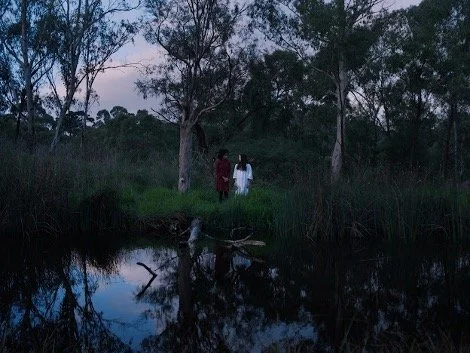
Location in The Offing.
Crozier: We were also interested in this one kind of off grid community that lives in the Yarra Ranges where we filmed many scenes. They exist as a commune and don't interact as much with the outside world, totally self-sufficient. And we kind of like the idea of these very benign communes and the potential it has to be corrupted by a figure that seeks power and preys on people who are just looking for community. So, yeah, we're very much inspired by real world communities and the trends in which they can be exploited by the wrong people.
Lunder: Yeah, we're very interested in hippie culture and alternate living. I feel like now, more than ever, people are searching for community, unity and safety. Which kind of makes them even more vulnerable to certain powers that want to abuse that - and you see that in a lot of those alternate living spaces. Not only in the cult, but even when the Freya and Neviah live at the caravan park.
“They're trying to find that sense of community throughout the whole film, but it's hard to find one where they actually feel safe as young women, because it doesn't exist.” - Lily Lunder
What is a story that you've always wanted to tell?
Lunder: I've always wanted to do like a crazy YA dystopia thing, because I grew up with that. I was always writing my little Hunger Games, Divergent fanfiction/ inspired stories as a kid.
Crozier: I feel like we gravitate very much towards grand worlds and grand set pieces, and I suppose one day, if we were endowed with such a budget, like, I think we'd love to do a film that speaks to a very epic world. One of our favourite films is Interstellar, where you've got, obviously, the grandeur of space, but then, also, there's dystopian films, where it's this huge world that, like, collapsing buildings, or a fantasy world. Like, I think we're very world driven but it would be fantastic to do a grand-world building epic.
Lunder: We just love developing the lore behind alternate worlds. And that's a little bit in this film, but I think we want to lean into it much more heavily in the future. And sometimes people talk about the offing and they say oh, the cult part worked so well why don’t you lean into that more? And I'm like, why don't we just make an entire cult film? So perhaps a project with more focus on that!
On the topic of future projects, what are you both working on? Together, and/or separately?
“ we've also finished the screenplay for our next feature film” -Koko Crozier
Crozier: we have a few short films on the slate. The screenplay leans slightly more into the genre space. It's kind of a horror romance that revolves around this very twisted relationship between two very troubled individuals which is very exciting
That is fantastic news! I wanted to ask you, Koko, about Bishops Hook Productions. How did it conceptualise and how did you choose the name?
Crozier: Yeah, I mean, it's very challenging to undertake a feature film, where there's so much risk involved, just by virtue of filmmaking, and what you subject yourself to, and not kind of protect yourself as an individual, and I think it just felt like the right decision to make a production company, logistically, and also begin that brand now. We are going to keep creating so having that vehicle to create things and start branding myself early on is helpful.
As for the name, my last name, Crozier, refers to the tip of a bishop's staff. I figured that tip is like a bishop's hook. So it’s a fun play on my last name.
Genius. Lily could you speak about Iris Artists Inc?
Lunder: I recently started Iris Artists after working for a council and learning more about the community arts space. It's an incredible vehicle for collaboration and to start creating a community of artists. Specifically, we really want to focus on female and gender diverse artists in screen.
“We are working on something with a retirement village at the moment, which is going to be one of our next shorts” -Lily Lunder
We’re excited to work more in the non-profit space and explore councils/local government. We want to try to make work kind of on a smaller scale through those avenues – in a way that is focused on community and collaboration.
This has been such an informative and engaging discussion, thank you. To wrap up with a final question: what advice would give to emerging filmmakers and some guidance on where to begin?
Crozier: I think it all comes back to finding your people and surrounding yourselves with like-minded creators, and I think very early on, when we started, we became very involved in all of the local communities, WIFT Victoria was a really great place to meet fellow gender diverse and women creatives, and also the ACS. Meeting Sue from Lee Mac, connecting with female cinematographers and volunteering on other projects, and that just made everything so much easier. Volunteering to help other filmmakers was instrumental because when we would assist with their projects, they would return the favour and collaborate with us on ours. So just surrounding ourselves with that team who would be our anchor in all our creative projects. I definitely recommend finding your people and sticking with them.
Lunder: I totally echo that. The biggest thing is about the importance of the community, because filmmaking is such a community art. Perseverance and grit are also integral, its not easy and it's a slog but its so rewarding and fun. There are so many things about it that I think discourage people but if you have the right people around you to be in the trenches together, it's so much easier. I’d say make something now if you can. its easy to get bogged down by funding concerns but You can start small and write something that is within your resources, those limitations are what make you more creative and you can do so much with so little.